
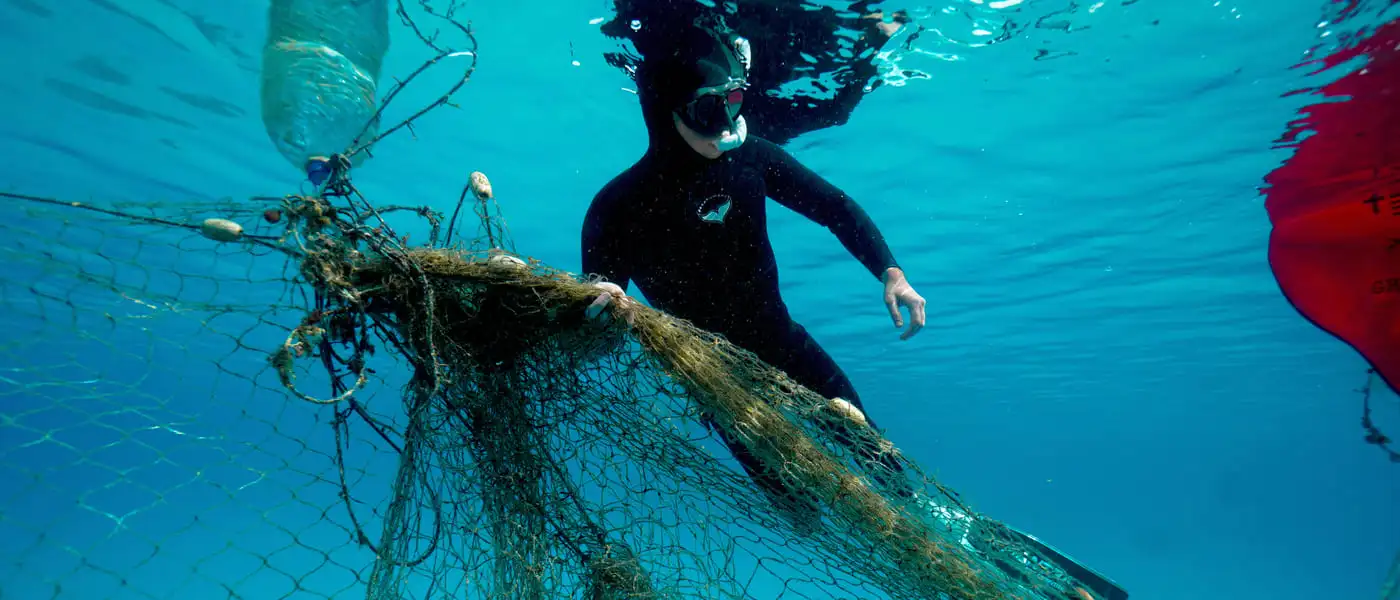
Ghost nets in Dahab
Conservation and collaboration with Ghost Diving Egypt
In January 2026, Ghost Diving Egypt conducted a collaborative ghost net retrieval mission in the Lagoona area of Dahab, Egypt — a project that highlighted not only the environmental impact of abandoned fishing gear, but also the importance of cooperation with local communities, scuba divers and freedivers.
The “Lagoona” in Dahab is not only a popular training and recreation site for divers and freedivers — it is also an important shallow reef that supports a wide range of marine life. It forms a mix of sandy bottom, coral patches, and gradual depth changes. It creates a nursery ground for juvenile fish and a habitat for numerous reef species. Because of its accessibility, the area is frequently used by local communities and visiting divers alike, which means any abandoned fishing gear left there can affect both biodiversity and human safety very quickly. Protecting Lagoona therefore helps safeguard not just marine ecosystems, but also the long-term sustainability of one of Dahab’s most important coastal dive sites.
Ghost nets discovered at Lagoona Reef in Dahab
The abandoned nets were first identified by local freedivers (Aline Hobi & Diana Garcia Benito), who shared footage on social media and tagged Ghost Diving.
Their initiative triggered contact between the divers and our team, ultimately leading to a coordinated response.
As the original footage had been taken some time before it was posted online, Ghost Diving Egypt first carried out a verification survey to confirm the nets were still present and assess the situation.
This made the planning and further removal safe and efficient.
A joint mission above and below the surface
The retrieval was conducted in collaboration with local freedivers and underwater photographer Aline Hobi.
The dive team worked in shallow but complex conditions — with good visibility of around 20 meters and a maximum depth of approximately 9 meters.
They recovered approximately 60 kilograms of abandoned fishing nets (gill nets) spread across several sections of the reef.
Although the operation itself was technically straightforward, the broader context required diplomacy and dialogue.
The ecological cost of ghost nets
The nets retrieved during the mission had already caused damage to marine life and reef habitats.
The original report included a Blacktip Reef Shark found deceased in the net. During the verification dive, the team also encountered a juvenile Reef Manta Ray entangled and dead, bearing evidence of a shark bite. In addition, pieces of coral were caught in the mesh. This is another clear evidence that ghost nets harm both individual animals and the structural integrity of reef ecosystems.
These findings reinforce a critical reality: ghost fishing begins immediately, and its effects extend far beyond what is visible at first glance.
Beyond removal: the value of documentation
This mission also highlighted the importance of visual documentation. Underwater photographers and videographers play a crucial role in translating underwater realities into public awareness.
Without their work, many ghost nets would remain hidden.
Working together for safer seas
The Dahab retrieval demonstrates what can be achieved when divers, local communities, authorities, and conservation organisations collaborate.
Ghost Diving Egypt continues to work toward:
- faster detection of lost fishing gear,
- stronger relationships with local stakeholders,
- long-term protection of vulnerable marine ecosystems.
Dahab’s reefs form part of the wider Red Sea ecosystem, one of the world’s most important marine biodiversity hotspots and a key destination for diving tourism.
Protecting these unique habitats is essential for marine life, local communities, and future generations.
If you encounter ghost fishing gear in your area, consider reporting it to local authorities or conservation organisations. Early reporting can prevent long-term damage to marine ecosystems.
Credits
- Organisation & Videography: Christina Ewerhardy
- Photography: Aline Hobi
- Divers: Sameh Sokar, Christina Ewerhardy, Kimberly Sokar, Karim Nagui, Aline Hobi
- Drivers: Karam Fekry, Ahmed Omar
- Freedivers: Khaled Elgammal, Diana Garcia Benito, Verena Thomas, Dion Murdoch, Mohamed Wahbi
- Logistics: Ghost Diving Egypt, Scuba Seekers